When you scale a campaign, the budget goes up quickly, and so does the cost of anything weak in it. The safest way to protect return on investment is to test creatives and offers before scaling your ad spend, so the big budget only goes behind what has already worked. This guide lays out a practical testing framework for media buyers: what to test first, how to keep a test clean, how much data is actually enough, how to read early signals, and how to decide what to scale and what to cut.
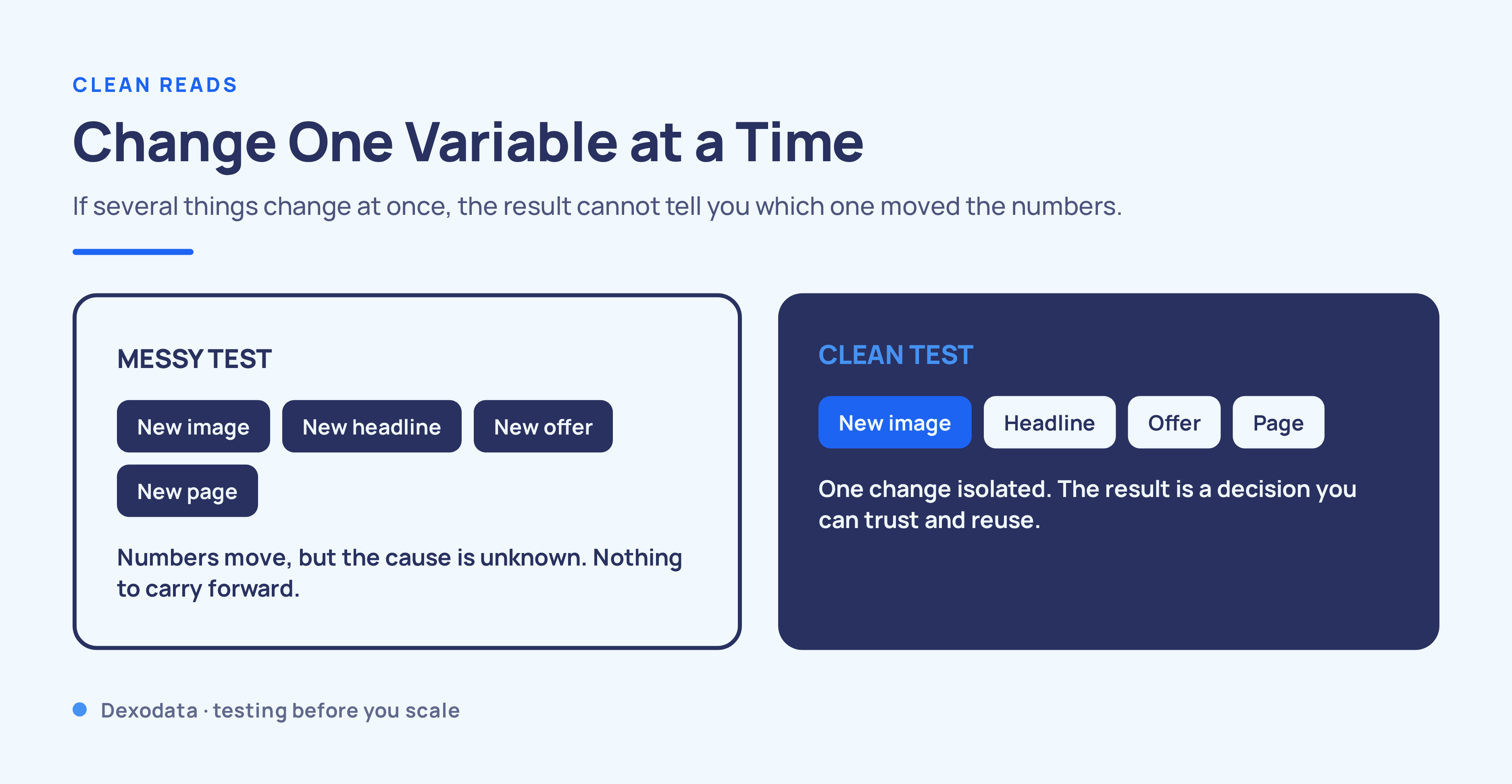
Scaling a funnel you have not validated is an easy way to waste budget. The moment the budget goes up, every weak creative, soft offer, and leaky landing page scales with it, and you only see the losses once the spend is gone. A short test phase gives you real numbers to work from before you put the money in.
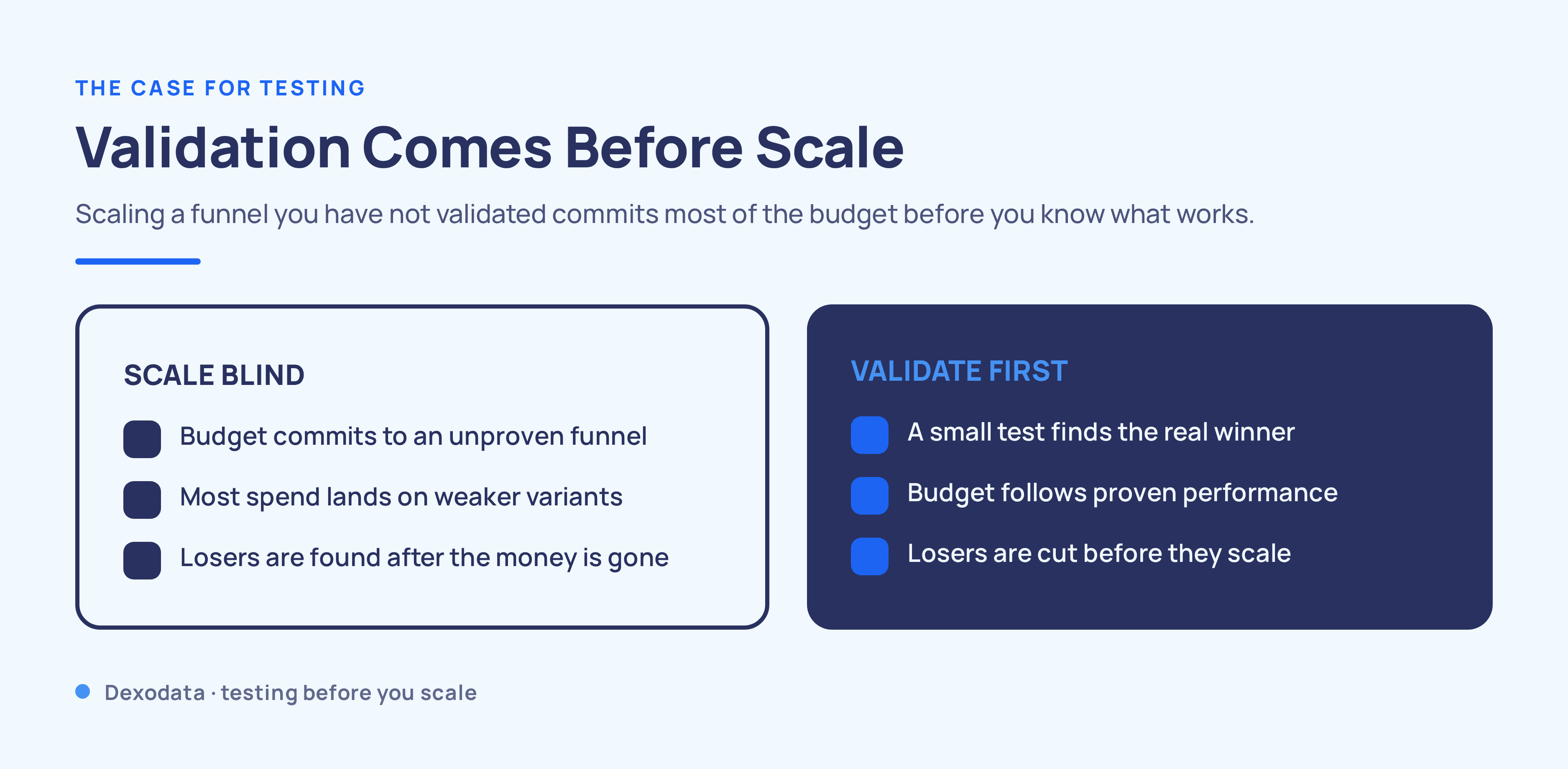
What to Test First
Not every element moves performance equally, so the order of testing matters. Start with creatives, because they drive the biggest early swings in attention and clicks. Move next to offers and angles, the promise you make and the way you frame it, which decides whether interest turns into intent. Finish with the landing experience, where that intent either converts or leaks away. Testing in this order keeps you from tuning a landing page for a creative you will end up replacing.
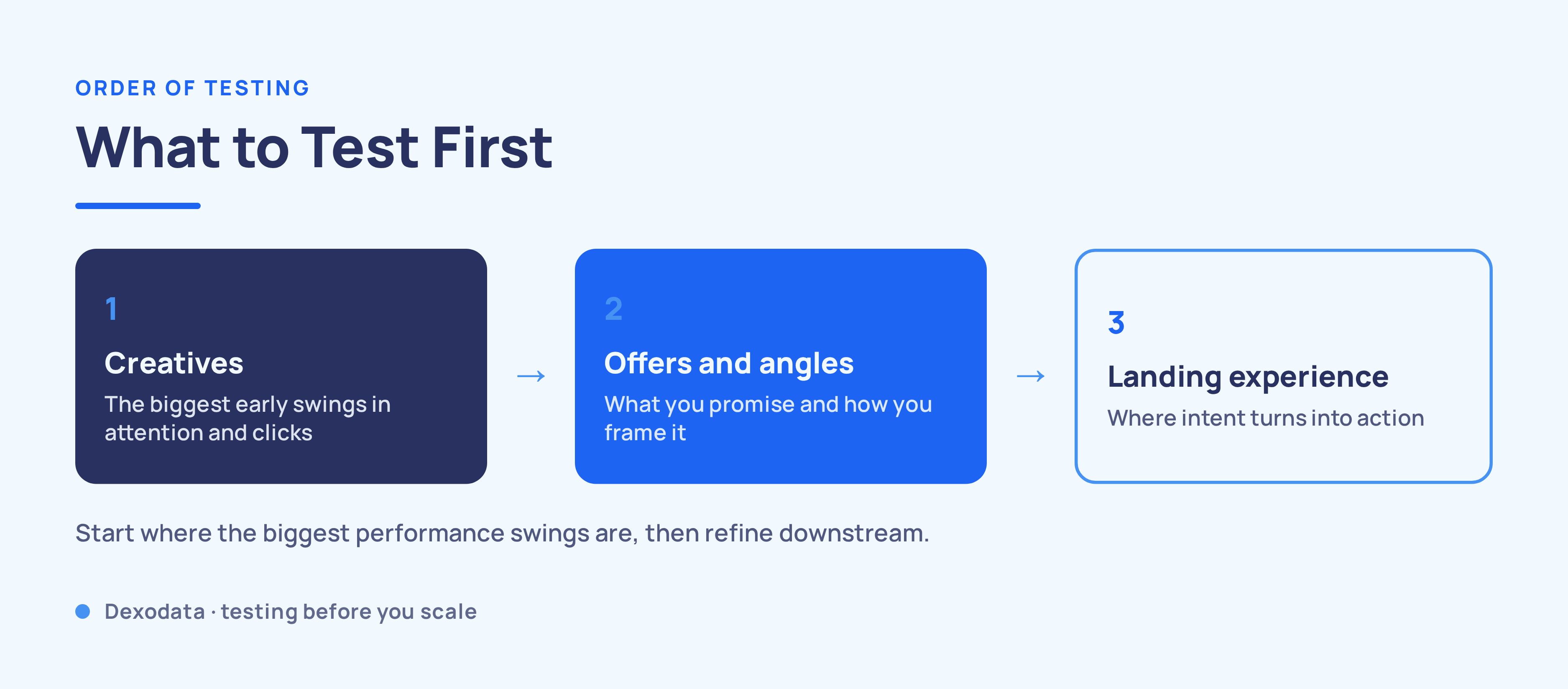
Split Testing: Change One Variable at a Time
A test only teaches you something when you can attribute the result to a single change. If a new variant swaps the image, the headline, the offer, and the page all at once, a lift or a drop tells you nothing about which change caused it. Isolate one variable per test, keep everything else fixed, and give each variant the same conditions. Keep the structure clean, and the test gives you a result you can trust and reuse next time.
Test for the Right Market, Not Your Own Screen
A clean test can still mislead you if you judge it from your own location instead of the market you are buying. From a single office connection, a landing page might load in the wrong language, show the wrong currency, hide the local payment options, or fire a geo redirect your real audience never hits. Rate a variant on that version, and you can drop a good one or put budget behind a weak one.
The fix is to check each creative, offer, and landing page from inside the target GEO, so you are reviewing what a local user actually sees. It is the same idea behind verifying digital ads from the audience side, applied to your own funnel before you commit budget.
A configurable proxy network such as Dexodata covers this part of the workflow. You can set the exact country, region, or city you are testing for, and keep each session consistent, so a difference between variants comes from the creative or the offer rather than the connection. That keeps the local check tied to the campaign instead of turning into a separate tool.
How Much Data Is Enough Before a Decision
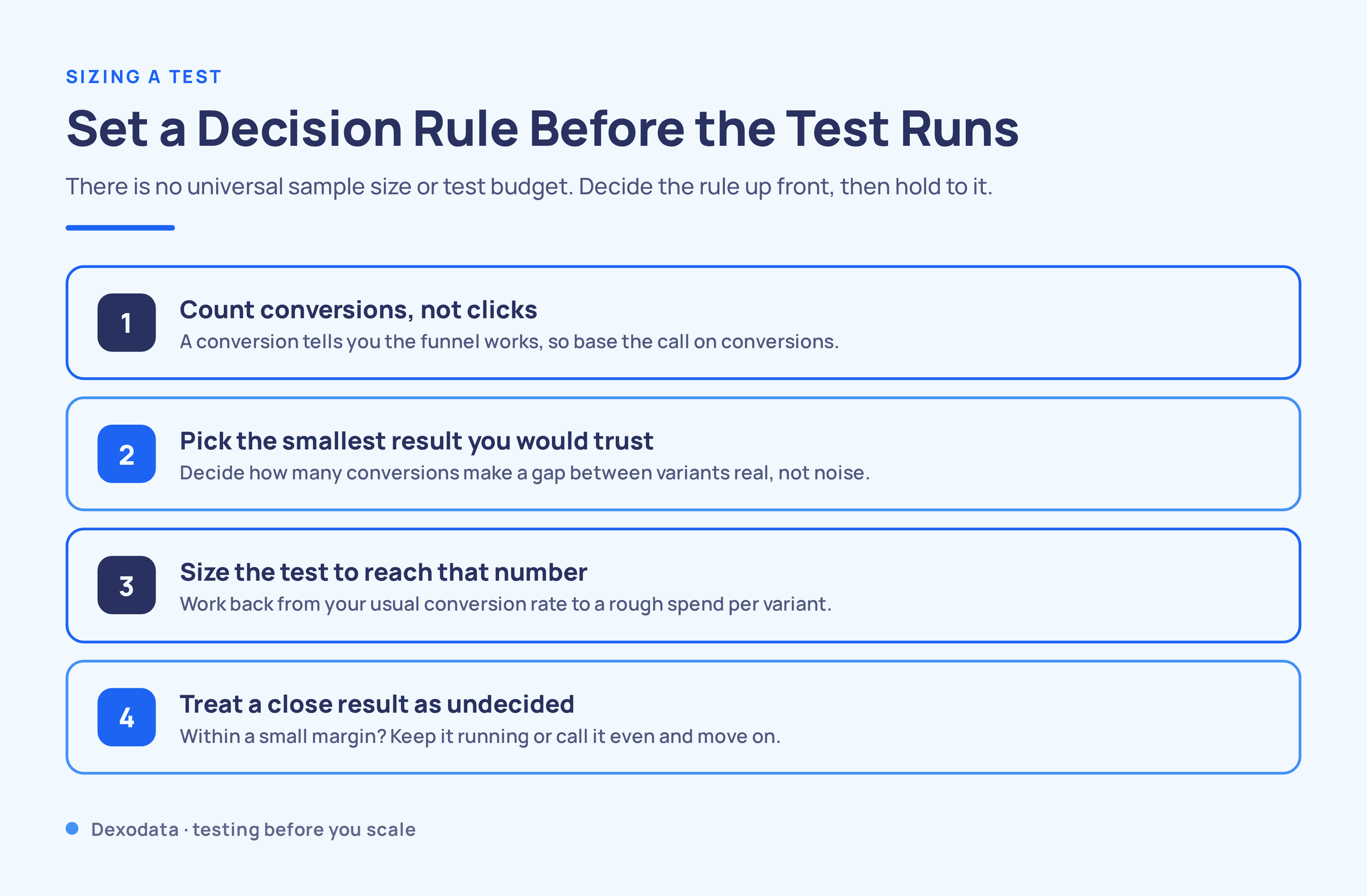
There is no universal sample size or test budget, because the data you need depends on your GEO, offer, bid, and the economics of the campaign. What you can do is set a clear decision rule before the test runs, so you are not guessing in the middle of it. A practical way to set one:
- Count the action that pays, not clicks. A click tells you a creative got attention; a conversion tells you the funnel works, so base the call on conversions.
- Pick the smallest result you would trust. Decide how many conversions you want on a variant before you treat a gap between variants as real rather than noise. The rarer and more valuable the action, the more you need.
- Size the test to reach that number. Work back from your usual conversion rate to a rough spend per variant that should produce those conversions, and use that as the test budget.
- Treat a close result as undecided. If two variants finish within a small margin, the test has not picked a winner yet; keep it running or call it even and move on.
As an illustration only, a buyer testing a cheap, frequent action might wait for a few dozen conversions per variant, while one testing a rare, high-value action might decide on fewer but watch them far more closely. The numbers are yours to set. The discipline is choosing the rule before you start, not in the middle when a variant looks good for a day.
Reading Early Signals
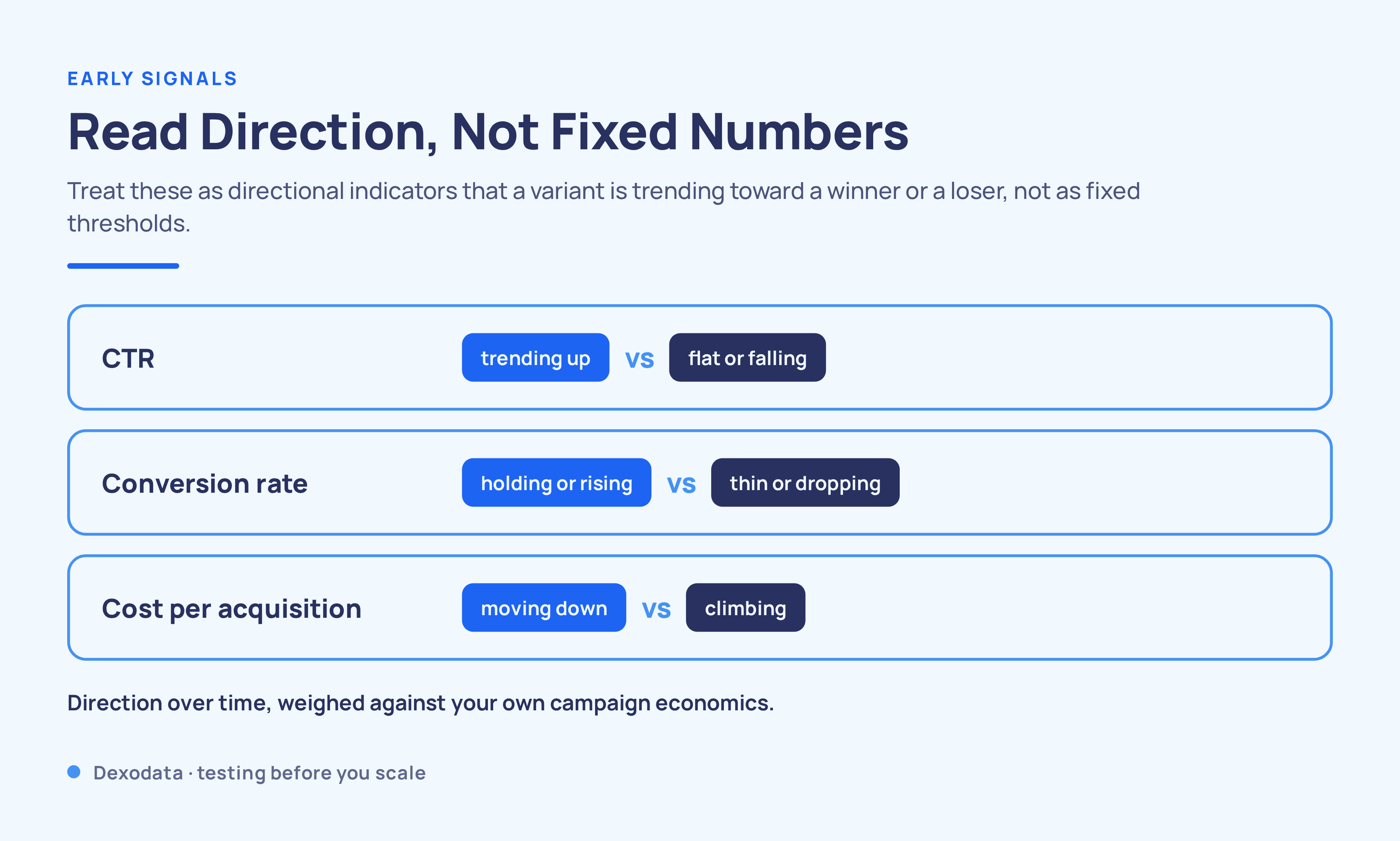
While a test runs, a few metrics hint at where a variant is heading. Read them as directional indicators, not as fixed thresholds. A CTR that trends up suggests the creative is earning attention, while one that stays flat or falls suggests it is not. A conversion rate that holds or rises as volume grows points to a genuine fit, while one that stays thin points the other way. Your cost per acquisition, the cost of a converted action on your own offer, is the signal that matters most: trending down is the encouraging sign, and climbing is the warning. Weigh each signal against your own campaign economics rather than a number borrowed from someone else.
| Signal | Trending toward a winner | Trending toward a loser |
| CTR | Rising | Flat or falling |
| Conversion rate | Holding or rising | Thin or dropping |
| Cost per acquisition | Moving down | Climbing |
The Go or Kill Decision
A test only pays off if you act on what it shows. Once a variant has had its fair run, you have three calls to make, and each one has a clear trigger you can set for your own campaign.
| The call | When to make it |
| Continue | It is ahead of your control on the metric that matters, but has not yet reached the result count you set. Let it keep running. |
| Stop | After a fair run, it is behind the control, or its cost per acquisition is drifting past your break-even. Cut it and move the budget to the next test. |
| Scale | It has reached your result count, held its lead as volume grew, and cleared your break-even with room to spare. It is ready for more budget. |
The usual mistake is keeping a variant alive because you want it to work. If it is behind after a fair run, stopping it is the call that protects the rest of the budget.
Cost of Testing vs Scaling Blind
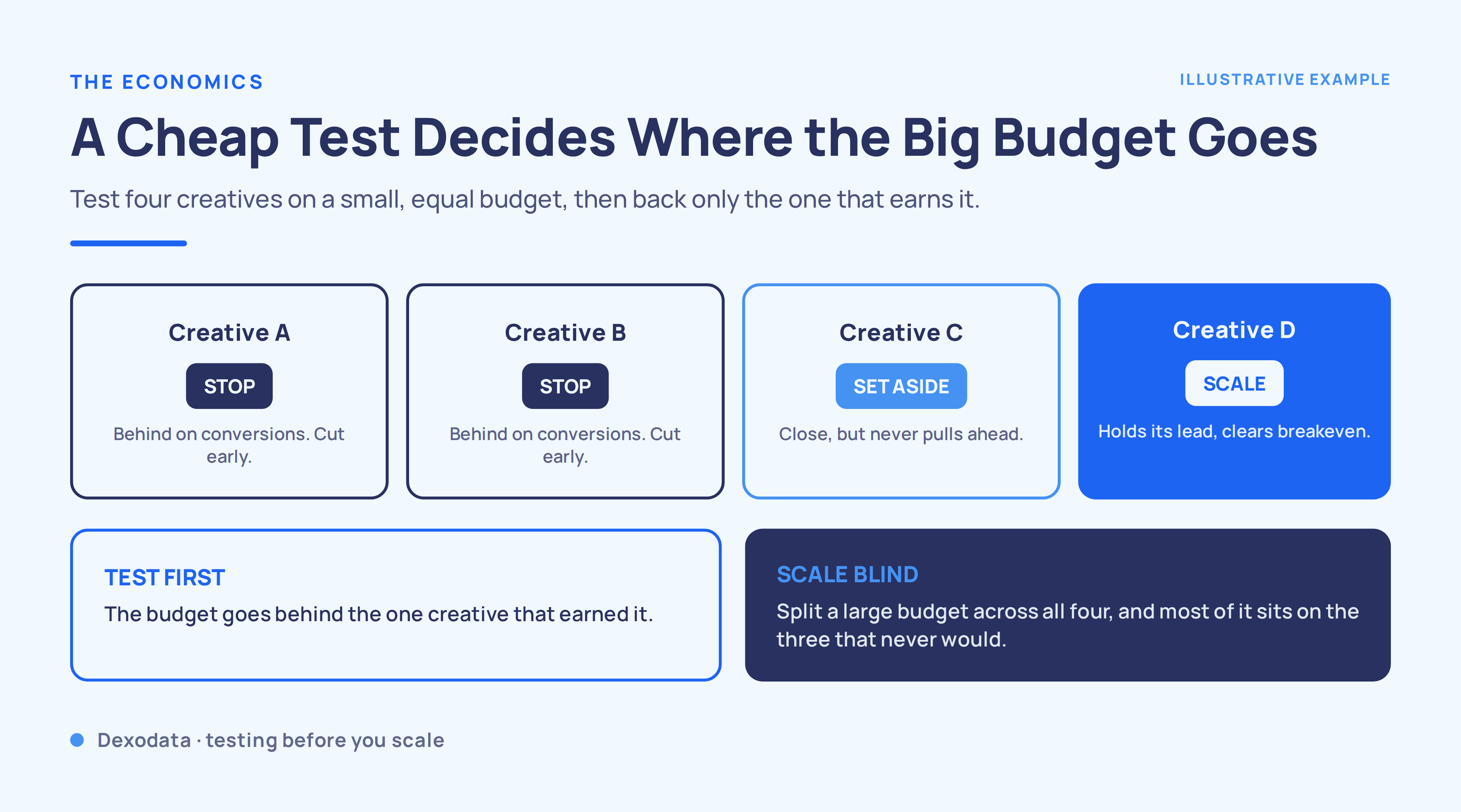
Put the two paths side by side with an illustrative case. Say you test four creatives on a small, equal budget each. Two fall clearly behind on conversions, and you stop them early. One stays close but never pulls ahead, so you set it aside. One holds its lead as volume grows and clears your breakeven, so it becomes the one you scale. Finding that out costs little. Skip the test and split a large scaling budget across all four, and most of it sits on the three that were never going to carry the campaign. The exact figures change with every campaign; the point is that a cheap test decides where the expensive budget goes.
Scaling the Winners
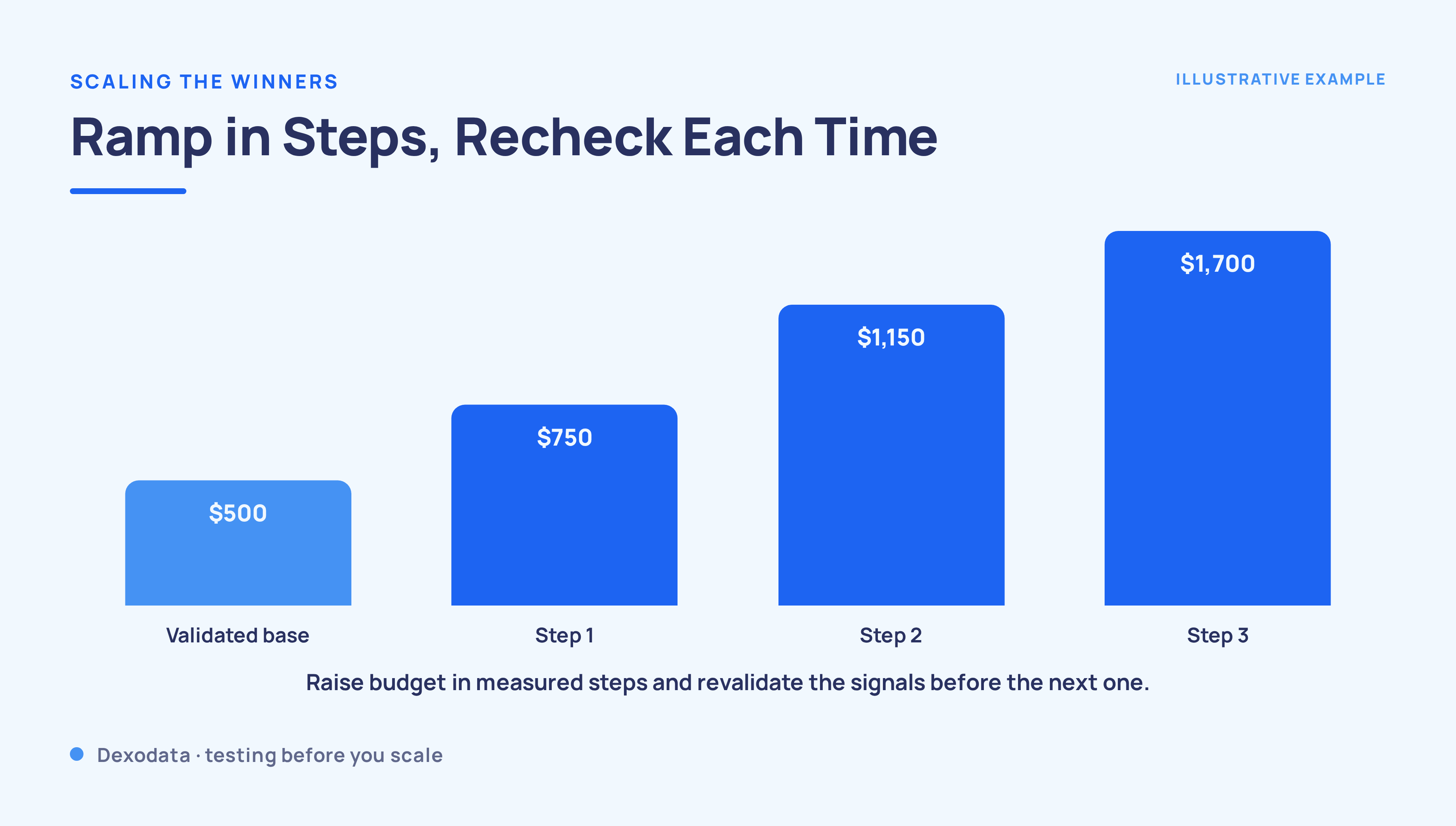
Once a variant has earned it, scale in steps rather than one jump. Raise the budget, let it gather fresh data at the new level, and check that the signals still hold and it still clears your breakeven before the next increase. In the illustrative ramp shown here, a base of $500 moves to $750, then $1,150, then $1,700, with a check at each step. Scaling this way keeps you close to the point where performance might slip, so you can pull back early instead of after the damage is done.
Frequently Asked Questions
What should I test first, creatives or offers?
Creatives first, because they produce the biggest early swings in attention and clicks. Then test offers and angles, and finally the landing experience, so you are never tuning a page for a creative you will replace.
How many variants should I test at once?
Enough to give you a meaningful comparison while still funding each one for a fair read. The exact count depends on your budget and the volume your market delivers, so there is no single right number.
How long should a test run before I decide?
Until it has had a fair run for your GEO, offer, bid, and campaign economics. There is no universal duration or sample size, so define what a fair run means for the setup before you start.
When should I kill a variant?
When, after a fair run, it is beyond your control or its cost per acquisition drifts past your breakeven. Cutting it early frees the budget for the next test instead of letting a loser drain it.
How do I scale a winning test without losing performance?
Raise the budget in steps, and before each raise, check that the signals still hold and the variant still clears your breakeven, so you can pull back the moment performance slips.
Conclusion
Testing before scaling is simple in principle: find what works on a small budget, then put the big budget there. Test creatives, then offers, then the landing experience; keep each test clean; read the signals as directions rather than fixed numbers; and only move budget to what has earned it. Scale the winners in steps, keep checking as you go, and let the numbers decide where the money goes.
About the author
This article was prepared by the team at Dexodata, a fully configurable proxy ecosystem with advanced traffic control, flexible routing, and precise GEO targeting. Learn more at dexodata.com.