Popunder, Push, and In-Page Push ads are widely used to drive paid traffic to advertisers’ offers. But rates and available traffic volumes are not the only factors to consider when comparing Popunder vs Push vs In-Page Push. Each format reaches users in its own way and can serve a particular purpose depending on the funnel stage. This guide takes a practical look at all three: how they work, when it makes sense to use each of them, what costs to expect, and how they can work together.
Popunder vs Push vs In-Page Push: Key Differences
Popunder, Push, and In-Page Push ads can all be used to drive users directly to an advertiser’s landing page. The main distinction is what happens before the visit.
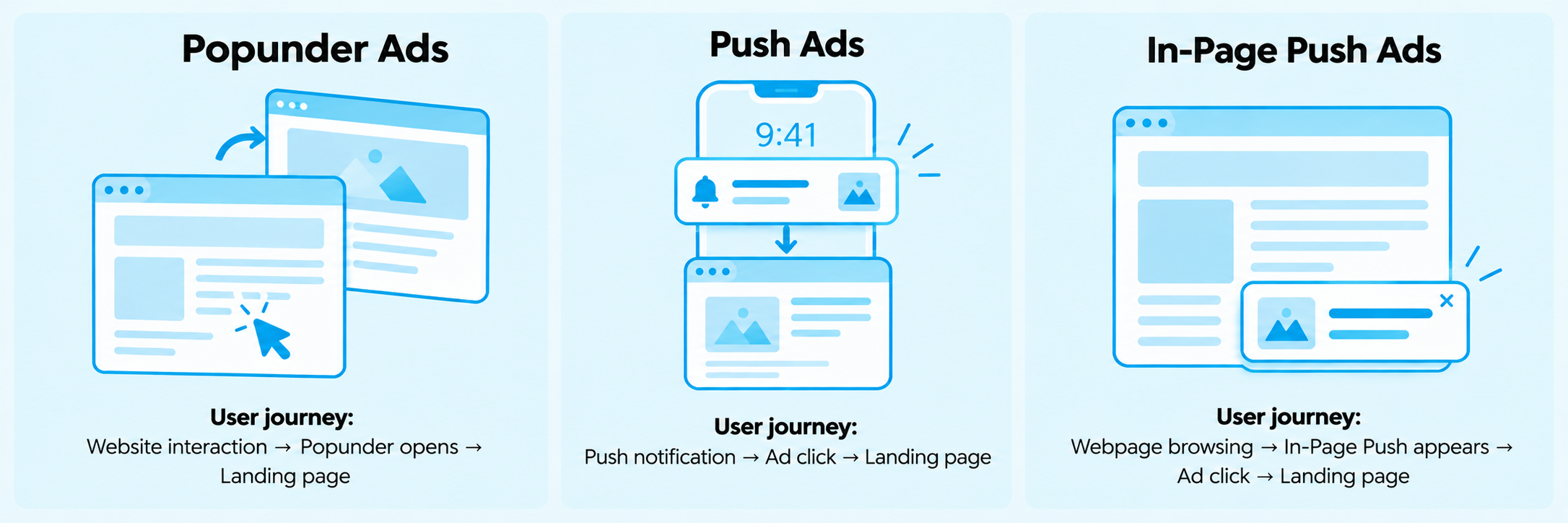
With Popunder, visitors reach the landing page without first clicking an ad creative, so the landing page itself makes the first impression. Push ads are delivered as notifications to users who have opted in to receive them. Users see the message first and decide whether to click through to the offer. In-Page Push ads resemble push notifications but appear on the webpage the user is browsing. They do not require notification opt-in. Users can just click the ad to visit the advertiser’s landing page.
Here’s a quick comparison:
| Feature | Popunder | Push | In-Page Push |
| Where it appears | New browser tab or window | Device/browser notification | On a webpage |
| User subscription | Not required | Required | Not required |
| Creative requirements | Landing page only | Headline, text, icon/image | Headline, text, icon/image |
| Device compatibility | Desktop and mobile browsers | Supported browsers and devices; limited on iOS | Desktop and mobile, including iOS |
| Common pricing models | CPM | CPC, CPM | CPC, CPM |
Popunder, Push, and In-Page Push Ads Explained
Popunder Ads
Popunder ads open an advertiser’s landing page in a new browser tab or window, usually after a user clicks or taps on the website they are viewing. The page opens in the background and typically becomes visible when the user switches tabs or closes the original page.
This puts more responsibility on the landing page. There is no headline or image to introduce the offer before the visit, so the page needs to catch attention and communicate its value quickly.
Push Ads
Push ads are notification-style ads delivered to users who have previously opted in to receive notifications. Unlike ads that appear only while someone is browsing a particular website, push can reach subscribed users outside the site where they originally opted in.
A Push ad combines a short headline, message, and image or icon. Advertisers can test these elements in different combinations to attract audiences interested enough to click. Because subscribers may see Push ads repeatedly, creatives also need regular updates as performance declines over time.
In-Page Push Ads
In-Page Push ads use a notification-like design but appear directly within a webpage while the user is browsing. Despite the name, they are not actual Push notifications and do not require a subscription beforehand. Because delivery does not depend on a Push subscription or browser notification support, the format can reach a broader mobile audience, including iOS users.
Like standard Push, In-Page Push lets advertisers show users an ad before they reach the landing page. Advertisers can test headlines, messages, and visuals to see which combinations are the most effective.
Which Ad Format Fits Different Campaign Scenarios?
When You Need Large Traffic Volumes at a Lower Cost
Popunder is a good fit for ad campaigns that need a steady flow of traffic without a high cost per visit. The format suits broad-audience offers that need enough volume to generate conversions and optimize by source.
It is widely used for iGaming, Dating, Sweepstakes, Software, and Web Utilities. On AdOperator, some of the largest Popunder volumes are currently available in India, with around 307 million impressions per day, and Indonesia, with around 164 million. Both GEOs also have relatively low typical rates of $1–2 CPM.
Example: A licensed online casino targeting players in the Philippines can use Popunder to promote a welcome offer and drive traffic to its landing page, subject to local advertising requirements. The advertiser can then track registrations and first deposits to identify the most profitable traffic sources.
When You Have a Specific Offer to Promote
Push works well when there is a clear message that can attract attention before the user visits the landing page. It can be a bonus, discount, new feature, limited-time deal, or another specific reason to click. The headline, image, and short description give advertisers room to present that message directly in the notification.
Push is commonly used in iGaming, Dating, eCommerce, Finance, Software, and other verticals to promote specific offers or benefits. Advertisers can also run several creatives for the same offer to see which messages generate more clicks and conversions.
Example: A sportsbook can use Push to promote a bonus tied to a major football match. The notification introduces the bonus and sends interested users to a landing page with the full terms and registration form.
When Mobile Reach Is a Priority
In-Page Push is worth considering for campaigns where a large share of the target audience uses mobile devices. It works across a wider range of browsers and operating systems than classic Push and does not depend on a notification subscription.
This can be useful for Mobile Apps, Dating, iGaming, Sweepstakes, and eCommerce. On AdOperator, the US currently has around 33 million In-Page Push requests per day, with an average CTR of approximately 3.5%. In India, approximately 8.6 million daily requests are available, with an average CTR of around 2%.
Example: A dating service targeting mobile users in the US can run In-Page Push to promote a simple signup offer on both iOS and Android. The advertiser can then optimize the campaign by device, OS, and traffic source based on registrations.
When You Are Testing a New Offer
If you need lower-cost traffic and have a landing page ready to test, Popunder can be a good starting point. Push or In-Page Push may be a better fit when you want to compare several messages and creatives before users reach the page. If there is no clear choice, run separate tests and compare the final conversion cost.
Previous campaign results and experience with similar offers can also help narrow down the choice. At AdOperator, every advertiser gets a personal manager regardless of spend, so you can ask for recommendations on the format, GEO, targeting, and initial campaign setup even if you are starting with a small test.
Example: A Dating advertiser entering a new GEO can review available traffic and rates with their manager, check what has worked for similar offers, and choose the format and targeting for the first test based on that data.
* Traffic volumes and rates are approximate and may vary depending on targeting, OS, source, time of day, and current demand.
How Much Do Popunder, Push, and In-Page Push Ads Cost?
Popunder, Push, and In-Page Push use different pricing models, so their rates cannot be compared directly. The tables below show three GEOs with some of the largest traffic volumes for each format on the AdOperator platform.
Popunder traffic is commonly bought on a CPM basis, with advertisers paying for every 1,000 impressions.
| GEO | Typical CPM | Available Popunder Traffic on AdOperator |
| India | $1.00–2.00 | ~307M impressions/day |
| Indonesia | $1.00–2.00 | ~164M impressions/day |
| The United States | $2.50–4.00 | ~76M impressions/day |
Push traffic is commonly priced by CPC, so advertisers pay for each click. Here, request volume alone does not show how many visits a campaign can potentially receive. Estimated click volume helps advertisers assess potential visits.
| GEO | Typical CPC | Available Push Traffic on AdOperator | Estimated Click Volume* |
| India | $0.004–0.006 | ~314M requests/day | ~530K/day |
| Indonesia | $0.01–0.015 | ~188M requests/day | ~525K/day |
| Pakistan | $0.003–0.006 | ~87M requests/day | ~95K/day |
In-Page Push traffic is also commonly bought on a CPC basis.
| GEO | Typical CPC | Available In-Page Push Traffic on AdOperator | Estimated Click Volume* |
| The United States | $0.003–0.005 | ~33M requests/day | ~1.1M/day |
| France | $0.003–0.004 | ~7.4M requests/day | ~245K/day |
| India | $0.003–0.004 | ~8.6M requests/day | ~170K/day |
AdOperator advertisers can check the Rate Card directly on the platform to see current traffic volumes and rates by GEO and use this data when planning or adjusting their campaigns.
How to Compare Costs Across Ad Formats
CPM and CPC show how you pay for traffic, but not how much a conversion will ultimately cost. A lower CPM or CPC does not automatically mean a lower acquisition cost if fewer users complete the target action.
When comparing formats, focus on the metric that reflects your campaign goal, for example, CPA, CPL, CPI, cost per registration, or cost per deposit. This gives you a much better basis for deciding what works best for your offer.
* Estimated click volume is calculated from requests and average CTR and is not a guaranteed number of clicks. Rates are indicative market ranges and may vary depending on OS, traffic source, time of day, targeting, and current auction conditions. Traffic and rate data are current as of October 2026.
How to Combine Popunder, Push, and In-Page Push
Using more than one ad format can help scale a campaign beyond the traffic available from a single format. For example, Popunder can provide enough volume to identify strong sources and build a whitelist of high-performing placements. Once the campaign has enough data and stable performance, Push or In-Page Push can be added to reach a larger audience in the same GEO. The same principle works in reverse: if Push volume is limited, Popunder or In-Page Push can provide another route to scale.
Formats can also serve different stages of the marketing funnel. For example, the first campaign may focus on generating registrations rather than an immediate purchase or deposit. Those registered or otherwise engaged users can then become the audience for the next campaign, where the goal is to promote the actual offer and generate revenue. The format that works well for acquisition does not have to be the best one for this next step. We cover this approach in more detail in our guide to optimizing marketing funnels for paid traffic.
Retargeting connects these stages. With a retargeting pixel, advertisers can build audiences based on previous interactions with the landing page – for example, users who registered, visited a specific page, or completed another tracked action. They can then run a retargeting campaign through Push or In-Page Push and promote a more relevant offer or message.
AdOperator supports cross-format Audience Retargeting, so an audience collected through one format can be used with another. Advertisers can compare the performance of different combinations and allocate more budget to the campaigns that generate revenue and deliver a stronger ROAS. Read more about the setup and use cases in our guide to Audience Retargeting Strategies.
Which Ad Format Should You Choose?
The right format depends on what you need from the campaign. The goal may be to bring enough traffic to find converting sources, present a specific message before the visit, reach people across more devices, add new sources to a campaign that already performs, or move an existing audience to the next step.
The choice can also change as the campaign develops. A format that works well for initial acquisition may not be the best option for scaling or retargeting. If you are planning a launch with AdOperator, ask your personal manager for recommendations based on your particular offer, target market, and budget, and use that information to choose a starting format and campaign setup.
Frequently Asked Questions
What is the difference between Popunder, Push, and In-Page Push ads?
Popunder is a strong option when you need large traffic volumes at a lower cost and can rely on the landing page to capture attention. Push works well when you want to show users a message or promotion before they visit the landing page. In-Page Push also uses notification-style creatives, but does not require a subscription and can reach a broader range of devices than classic Push.
Is Push or In-Page Push better for mobile traffic?
Both formats can reach mobile users, but In-Page Push is less dependent on browser notification support because the ad appears directly on a webpage. It does not require a Push subscription and can also reach iOS users. Classic Push can be useful when you want to reach people who have already subscribed to notifications, including outside the website where they opted in.
Can I use Popunder, Push, and In-Page Push in the same campaign strategy?
Yes. They can be used together for scaling or at different stages of the funnel. For example, one format can bring the initial traffic or registrations, while another is used to reach an existing audience with a follow-up offer. With cross-format retargeting, advertisers can also build an audience through one format and reach it later through another.