
AI is changing the customer journey and the way people make decisions before reaching a brand’s website. A user may see an ad, visit a landing page, and convert, but their decision can start much earlier with AI-assisted research.
This makes it harder to understand which interactions contributed to the final decision. In this article, we’ll use recent Similarweb research to explore how AI is reshaping the customer journey and what advertisers can do to adapt their campaigns and measurement.
AI in the Customer Journey
AI assistants like ChatGPT, Gemini, and Claude are becoming part of the research process, helping users compare options, explore unfamiliar products, and narrow down their choices before they ever visit a brand’s website. This doesn’t mean AI is replacing search engines or paid advertising – it’s becoming another touchpoint in the customer path.
This shift is reflected in a recent Similarweb report titled "The Downstream Impact of AI Visibility." The researchers tracked thousands of real customer journeys after ChatGPT recommended a specific brand, following users for 7 days after the AI interaction. The results were striking: people were 2.5 times more likely to visit the recommended brand than a direct competitor, even though they hadn’t clicked a link during the AI conversation. For performance marketers and advertisers, this makes AI visibility relevant even when it generates no immediately measurable traffic.
How Users Discover Brands Today
People discover brands less linearly: they no longer move directly from a search query or an ad to a website. By the time users arrive, they may have already explored alternatives and formed initial preferences through AI-assisted research.
Today’s customer path often includes more touchpoints: they may switch devices, channels, or return days later, making the way to conversion less predictable. A simplified comparison looks like this:
| Traditional customer journey | Today’s customer journey |
| Ad / Search → Website → Conversion | AI → Search / Paid Ads / Reviews → Website / Landing Page → Retargeting → Conversion |
Similarweb report shows that 55.9% of AI-influenced visits came through Search, compared with 40.4% of standard visits. In other words, users don’t necessarily click a link in ChatGPT. In many cases, they remember the recommendations, return to Google a few days later, and open the website from there.
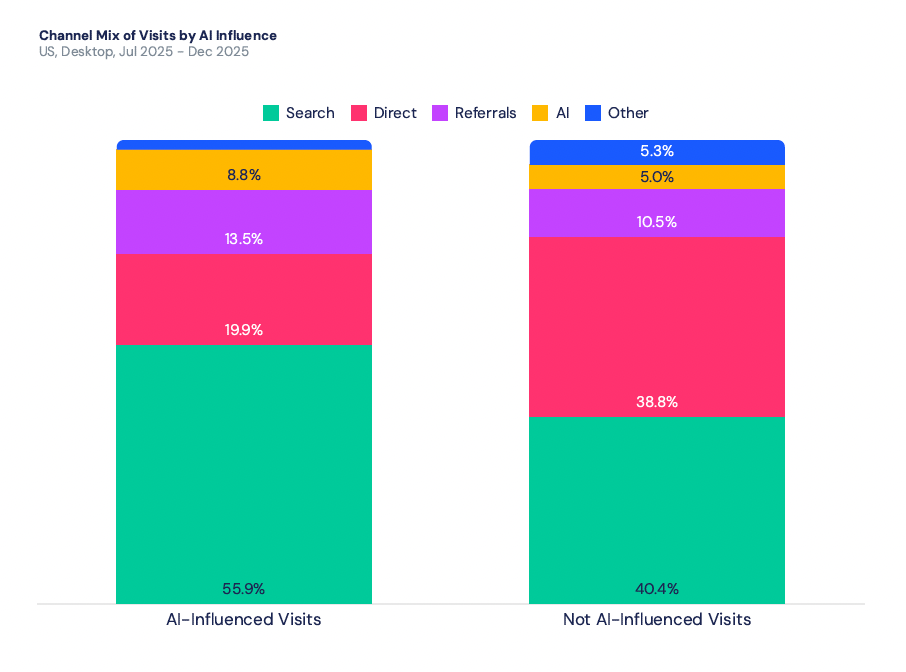
Source: "The Downstream Impact of AI Visibility" report, Similarweb.com
This is an important signal: the channel that drives conversion may not be the channel that first influenced the user.
How AI Is Changing Marketing Attribution
When a user discovers a brand through AI and visits the website several days later, analytics usually attributes it to Search. Earlier AI interaction often stays invisible. From an analytics perspective, this looks like ordinary search traffic. In reality, the customer journey could have started long before.
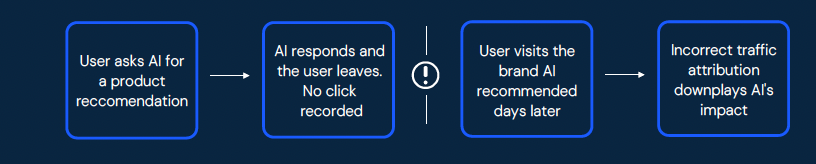
Source: "The Downstream Impact of AI Visibility" report, Similarweb.com
This is exactly what Similarweb calls the attribution gap. AI doesn’t necessarily generate immediate clicks, but it can influence future website visits that happen through other channels. As a result, relying on referral traffic or last-click attribution alone no longer provides the full picture.
Traditional attribution models still have their place. However, as customer journeys become more fragmented, advertisers should keep in mind that the last click often represents only the final interaction, not the entire decision-making process. Metrics such as assisted conversions and the time between the first interaction and conversion can provide a more complete picture of campaign performance.
How Advertisers Can Adapt to the New Customer Journey
Stay Visible Across Channels
Staying visible is now more important than winning particular interactions. Instead of planning every campaign as an isolated source of conversions, consider where its audience may be coming from.
This doesn’t mean being present everywhere. The goal is to identify the channels that matter the most and make them work together. For example, one can send users directly to an offer, while another can deliver a push notification to people who have visited the website before.
Use Audience Retargeting to Reconnect
When users rarely convert after a single interaction, retargeting helps continue the conversation with people who have already shown interest and tailor the next message to what those people already know.
In AdOperator, advertisers can use a tracking pixel to build separate audiences at different stages. For example, a pixel can be placed on a landing page, after registration, or after another specific action. These audiences can then be targeted with separate campaigns based on how far users have progressed toward conversion.
Learn how to set up audience retargeting in AdOperator →
Adapt Your Message to the User’s Stage in the Journey
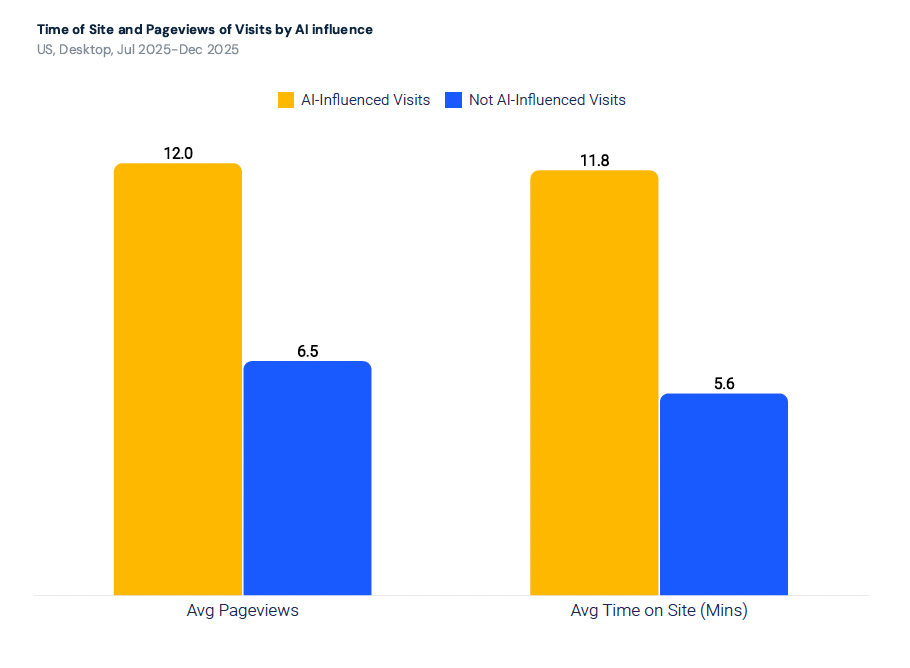
Similarweb found deeper on-site engagement among AI-influenced visitors: they viewed 12.0 pages on average, compared with 6.5 for other visitors, and spent 11.8 minutes on site versus 5.6 minutes. The report suggests that these users arrive after doing more research and narrowing down their options.
Source: "The Downstream Impact of AI Visibility" report, Similarweb.com
When possible, align campaign creatives, landing pages, and calls to action to how familiar users already are with the offer. A prospecting campaign can introduce the product and its value, while campaigns aimed at warmer audiences can focus on a more specific reason to return or take the next step.
Monitor AI Visibility Alongside Search Demand
AI visibility can also serve as an indicator of future interest. Track whether your brand appears in relevant AI responses, which competitors are recommended for the same queries, and whether changes in that visibility coincide with changes in branded search or website visits.
This shouldn’t replace campaign metrics. It adds another signal that can help explain where demand may be forming before it displays in performance reports.
Conclusion
AI is adding another layer to the customer journey. Users can discover a brand through an AI recommendation, continue their research through Search, interact with an ad, and return later before they are ready to convert. The final visit may be easy to measure, while the interactions that influenced it are much harder to see.
For advertisers, the goal isn’t to replace existing channels or attribution models. It’s to understand what role different interactions play, reconnect with audiences when needed, and evaluate campaigns in the context of the broader customer journey. As AI plays a larger role in brand discovery, looking beyond the final click can give advertisers a better understanding of how users convert.